Understanding 111.90.150.1888 and Its Technical Meaning in Networking
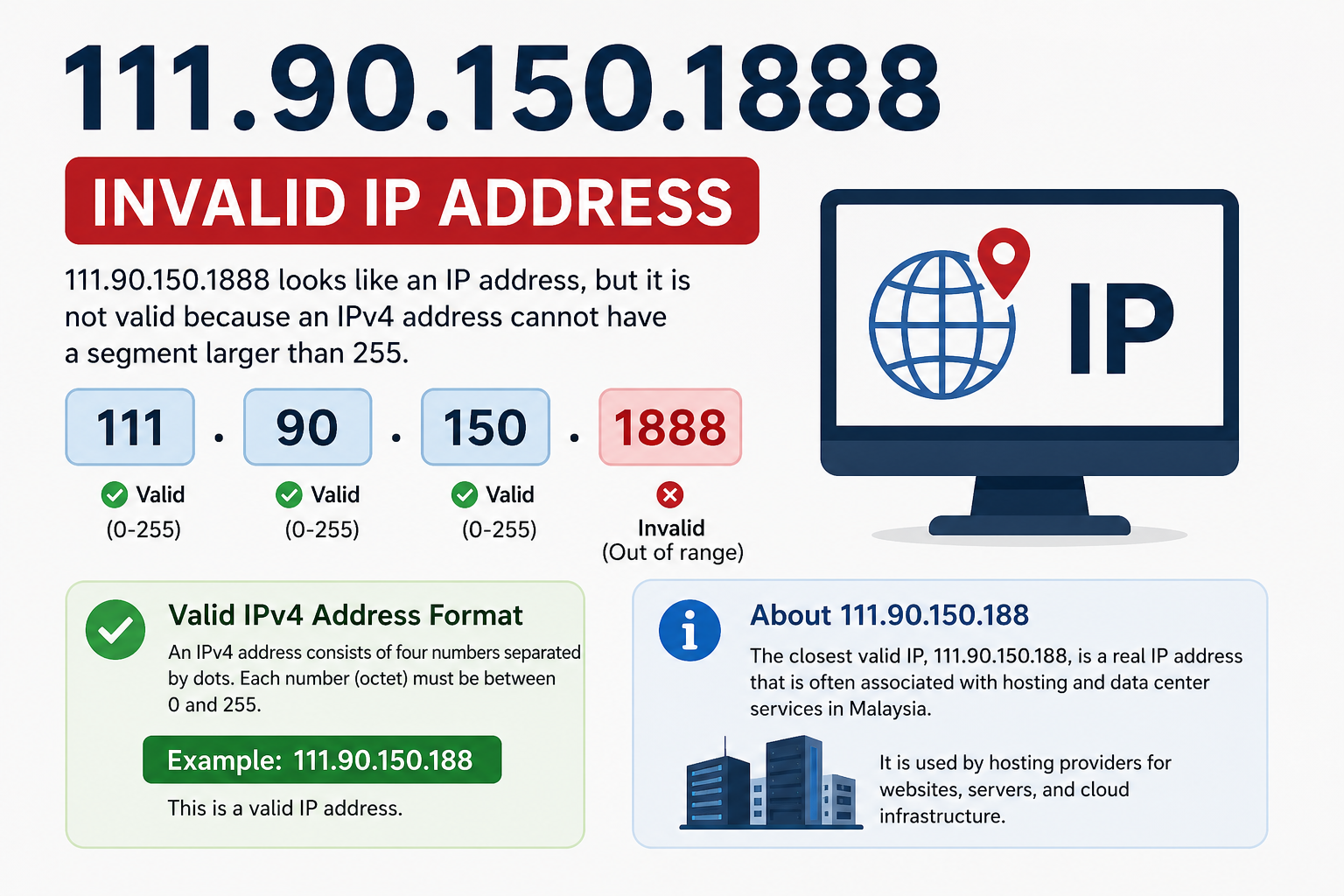
The string 111.90.150.1888 appears to resemble an IPv4 address, but in reality, it is not a valid network identifier. In standard IPv4 formatting, every IP address consists of four numerical segments separated by dots, and each segment must stay within the range of 0 to 255. Since the last segment “1888” exceeds this limit, the entire structure becomes invalid for internet communication systems.
In real networking environments, invalid IP formats like this are automatically rejected by routers, servers, and DNS systems. This ensures that only properly formatted and routable addresses are used for communication across the global internet infrastructure. Because of this, 111.90.150.1888 cannot be assigned, traced, or used as a functional IP address.
Why 111.90.150.1888 Is Not a Valid IPv4 Address
IPv4 technology is built on a 32-bit addressing system that divides an IP into four octets. Each octet represents 8 bits of binary data, which limits its maximum decimal value to 255. This is why valid IP addresses such as 111.90.150.188 exist, while values exceeding 255 break the system rules.
The presence of “1888” in the final segment is mathematically incompatible with binary-based networking architecture. Any system attempting to parse this value will flag it as an error. This is not just a technical limitation but also a safeguard that keeps internet routing stable and prevents malformed data from entering communication channels.
Correct Form of Similar IP Address 111.90.150.188
If we correct the malformed version, the closest valid representation becomes 111.90.150.188, which follows proper IPv4 formatting rules. This type of IP often belongs to hosting environments or data center infrastructures rather than personal residential connections.
According to geolocation data, IP ranges similar to 111.90.150.xxx are frequently associated with hosting providers such as Shinjiru Technology Sdn Bhd in Malaysia, which operates cloud servers and data center services. For example, real-world lookup systems show that IPs in this range are typically used for web hosting, server infrastructure, or enterprise networking services rather than individual users.
Real-World Geolocation of 111.90.150.188 Range
When analyzing legitimate IPs within this range, geolocation tools often map them to Kuala Lumpur, Malaysia. These IPs are commonly linked to data center operations rather than residential ISPs. For example, network data shows that IPs under the ASN 45839 belong to Shinjiru Technology, a hosting provider operating in Malaysia’s digital infrastructure sector.
Such IPs are typically used for cloud hosting, virtual private servers, and website deployment services. This explains why they may appear in logs of websites or applications rather than personal devices. However, it is important to understand that geolocation data only reflects the hosting server location, not the actual end-user identity.
Why Invalid IP Formats Like 111.90.150.1888 Appear Online
One of the most common reasons for seeing invalid IP formats online is typographical error. Users may accidentally add extra digits or misunderstand IP formatting rules when copying or documenting data. This results in incorrect entries like 1888 instead of a valid range between 0 and 255.
Another reason is automated content generation or scraping errors. Some systems generate numeric strings without proper validation, leading to malformed outputs. In SEO spam or low-quality content, such invalid strings may also be used intentionally to attract search engine traffic, even though they have no technical meaning.
Importance of IP Address Validation in Internet Systems
IP validation is a critical part of internet infrastructure. Every time a device connects to a network, its IP address is checked for correctness before routing begins. If the system detects a value outside acceptable ranges, such as 1888 in an octet, the request is immediately rejected.
This validation prevents routing failures, security vulnerabilities, and potential system crashes. Without strict IP validation, malicious or corrupted data could disrupt communication between servers, leading to unstable internet services. Therefore, even a small formatting error like this can completely invalidate a network request.
Security Perspective on Malformed IP Addresses
From a cybersecurity standpoint, malformed IP addresses like 111.90.150.1888 are often irrelevant but still noteworthy. Attackers sometimes use incorrect or fake IP formats in logs or scripts to confuse security monitoring systems. However, modern intrusion detection systems are designed to filter out invalid entries automatically.
Security analysts also use IP validation to detect anomalies in network traffic. If invalid IPs appear repeatedly in logs, it may indicate bot activity, scraping attempts, or poorly configured applications. While 111.90.150.1888 itself is harmless, its presence in data systems can signal underlying issues in data integrity or input handling.
Role of Hosting Providers Behind Valid IP Ranges
Real IP addresses close to 111.90.150.188 are typically assigned to hosting providers operating large-scale data centers. Companies like Shinjiru Technology manage thousands of IPs for websites, cloud applications, and enterprise systems.
These providers ensure that IPs are distributed dynamically across servers based on demand. As a result, a single IP range can support multiple services, including web hosting, VPN nodes, and application backends. This makes such IPs essential components of modern internet infrastructure.
Common Misinterpretations of IP Address Data
Many users assume that IP addresses reveal exact personal information such as home addresses or individual identities. However, this is not accurate. IP geolocation typically shows only the approximate location of a server or ISP node, not the actual user behind it.
In cases like 111.90.150.1888, misunderstanding increases because the format itself is invalid. Users may mistakenly believe it represents hidden data or secret tracking information, but in reality, it is simply a non-functional string with no operational meaning in networking systems.
How IP Address Systems Maintain Accuracy and Reliability
Modern networking relies on multiple layers of validation to ensure accuracy. When a device sends data across the internet, routers, DNS servers, and firewalls all verify IP correctness before allowing transmission. This ensures that only properly structured addresses are processed.
If any segment violates formatting rules, such as exceeding the maximum value of 255, the system discards it instantly. This mechanism is essential for maintaining global internet stability, especially considering billions of devices communicate over IP-based networks every day.
Final Analysis of 111.90.150.1888 in Digital Context
The keyword 111.90.150.1888 does not represent a valid IP address and has no real networking function. It is best understood as a malformed or incorrectly formatted string rather than a technical identifier. Any legitimate analysis of this keyword leads back to IP formatting rules, which strictly prohibit values above 255 in any segment.
In contrast, similar valid IPs like 111.90.150.188 belong to real hosting infrastructures and are actively used in global internet systems. Understanding the difference between valid and invalid IP formats is essential for cybersecurity awareness, digital literacy, and accurate interpretation of network data.
Ultimately, 111.90.150.1888 serves as a useful example of why strict formatting rules exist in internet architecture. Without such rules, global communication systems would fail to operate reliably or securely.