Introduction
The IP-like string 111.90.150.284 has drawn attention from users who encounter it in logs, search results, or technical discussions. At first glance, it appears to be a standard IPv4 address, but many people question whether it is valid, safe, or even real. In today’s digital environment, where cybersecurity concerns are increasing, understanding such entries is essential for avoiding confusion and protecting systems.
This article provides a complete, well-researched explanation of 111.90.150.284. It explores its validity, possible origins, technical meaning, and security implications. By incorporating related keywords such as “invalid IP address,” “IPv4 format rules,” “malformed IP logs,” and “network security risks,” this guide delivers clear, trustworthy, and expert-level insights.

Understanding How IPv4 Addresses Work
An IPv4 address is a numerical identifier used to recognize devices on a network. It consists of four segments separated by dots, and each segment must fall within a specific range. These segments, often called octets, are essential for routing data across the internet and ensuring communication between systems.
Each octet in an IPv4 address must be a number between 0 and 255. This limitation exists because IPv4 uses a 32-bit structure, which defines the total range of possible addresses. If any segment exceeds this range, the address becomes invalid and cannot function in real-world networking.
The strict formatting rules of IPv4 are not optional. They are enforced by networking protocols and systems worldwide. Any deviation from these rules results in an address that cannot be assigned, routed, or recognized by network devices.
Why 111.90.150.284 Is an Invalid IP Address
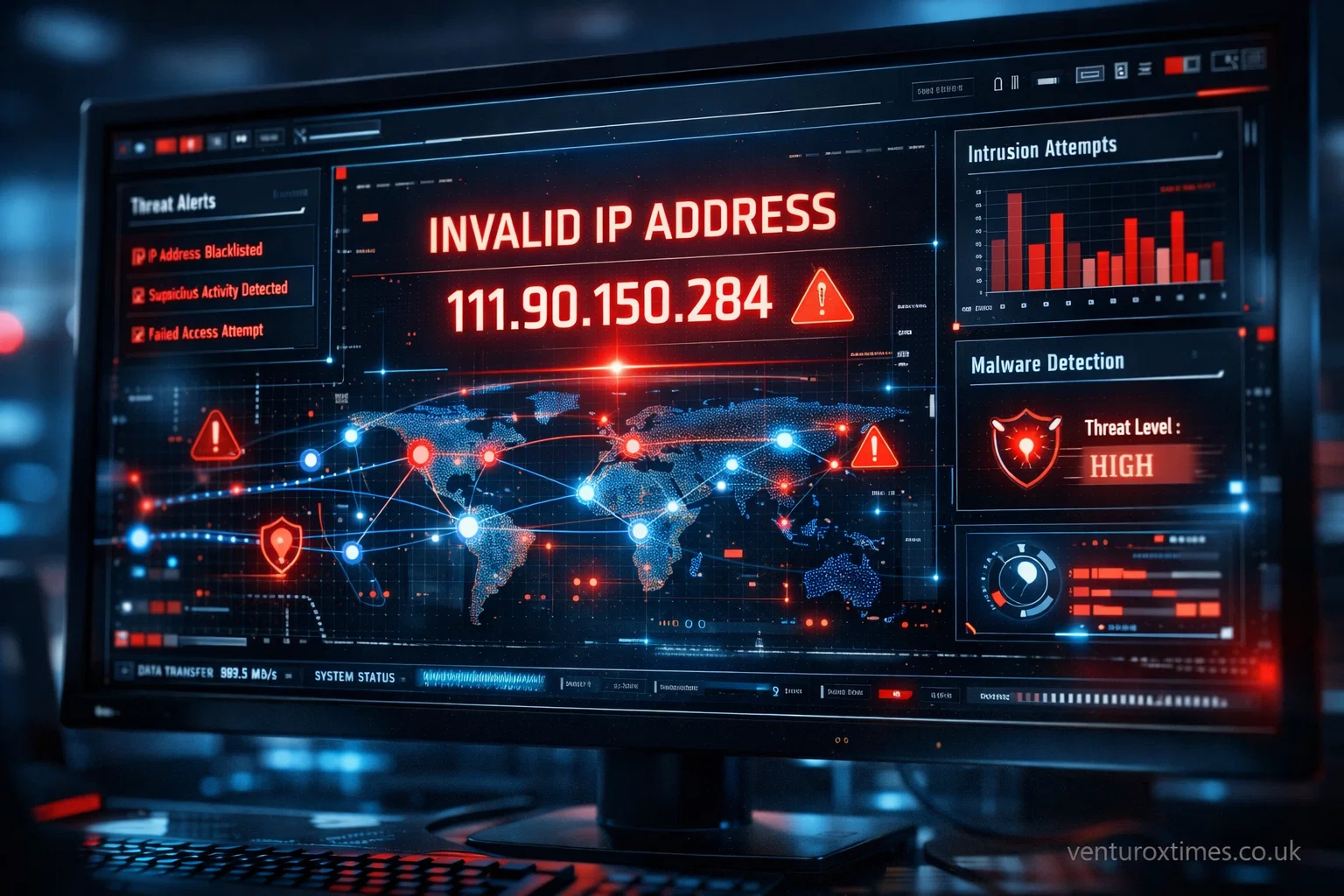
The string 111.90.150.284 may look like a proper IP address, but it fails a basic validation rule. The last segment, “284,” exceeds the maximum allowed value of 255. Because of this, the address does not meet IPv4 standards and is considered invalid.
Invalid IP addresses cannot exist on the internet or within local networks. They cannot be assigned to devices, used by servers, or accessed through browsers. Similar examples, such as addresses with segments above 255, are commonly identified as malformed or incorrect entries.
This means that 111.90.150.284 is not a real or reachable address. It cannot represent a server, user, or service. Any appearance of this string should be treated as a technical anomaly rather than a functional network identifier.
Common Reasons This Invalid IP Appears
One of the most common reasons for encountering 111.90.150.284 is a typographical error. A user or system may have intended to write a valid IP address but accidentally entered an incorrect number. Even a small mistake can produce an invalid result.
Another possible cause is software or logging errors. Automated systems that collect or process data may generate malformed IP addresses due to bugs or misconfigurations. These errors can appear in analytics dashboards, server logs, or indexed web pages.
In some cases, developers intentionally use invalid IP addresses as placeholders during testing. These non-functional values help simulate real-world scenarios without connecting to actual networks. While harmless, they can still create confusion when discovered outside their intended context.
Could 111.90.150.284 Indicate a Security Threat
The presence of an invalid IP address does not automatically indicate a security threat. However, the context in which it appears is important. In some situations, malformed data may be used to disguise malicious activity or confuse monitoring systems.
Attackers sometimes inject invalid or unusual data into logs to make analysis more difficult. By cluttering logs with incorrect entries, they can hide real threats or delay detection. This tactic is part of broader strategies used in cybersecurity evasion.
That said, most appearances of invalid IP addresses are harmless. They are more likely caused by technical errors than deliberate attacks. Proper investigation is necessary before assuming any malicious intent.
How Invalid IP Addresses Affect Network Logs
When an invalid IP address like 111.90.150.284 appears in server logs, it can create challenges for administrators. Logs are designed to track incoming requests and identify sources of traffic. Incorrect data disrupts this process and reduces accuracy.
For example, an invalid IP cannot be traced back to a real location or device. This makes it difficult to analyze traffic patterns or identify suspicious behavior. Over time, repeated invalid entries can clutter logs and complicate troubleshooting.
In some cases, these entries may reveal issues within the logging system itself. Misconfigured tools or incorrect parsing rules can produce invalid outputs. Identifying and fixing these problems is essential for maintaining reliable data.
How to Investigate and Handle Such IP Entries
If you encounter 111.90.150.284 in your logs, the first step is to examine the context. Look at associated timestamps, request types, and system activity to determine whether the entry is isolated or part of a larger pattern.
It is also important to validate your systems. Ensure that input fields, scripts, and logging tools are correctly configured to handle IP addresses. Implementing strict validation rules can prevent malformed data from being recorded.
If suspicious activity is suspected, reviewing firewall logs and intrusion detection systems can provide additional insights. Blocking unusual traffic patterns and monitoring repeated anomalies can help maintain network security.
The Importance of IP Address Validation
IP address validation is a critical aspect of network security and data accuracy. By enforcing strict rules, systems can reject invalid inputs before they cause problems. This improves both performance and reliability.
Modern applications often include built-in validation mechanisms that automatically detect incorrect formats. These tools can identify addresses like 111.90.150.284 and prevent them from being processed or stored.
Regular system updates and maintenance also play a key role. As networks evolve, ensuring that validation mechanisms remain up to date helps protect against both technical errors and potential vulnerabilities.
Best Practices for Managing Suspicious IP Data
Managing unusual or invalid IP entries requires a proactive approach. Monitoring logs regularly helps identify patterns and detect anomalies early. This allows administrators to respond quickly and effectively.
Training team members to understand IP address structures can also improve response times. When staff recognize what constitutes a valid or invalid address, they can handle issues more confidently and accurately.
Combining multiple security measures, such as firewalls, intrusion detection systems, and regular audits, creates a stronger defense. This layered approach ensures that both errors and potential threats are addressed efficiently.
Conclusion
The string 111.90.150.284 is not a valid IPv4 address because its final segment exceeds the allowed range of 0 to 255. While it may appear in logs or search results, it does not represent a real device or network location.
Understanding why such invalid entries occur helps reduce confusion and improve system reliability. Whether caused by typos, software errors, or testing data, these anomalies are usually harmless but should still be reviewed carefully.
By applying proper validation, monitoring systems, and security practices, you can ensure accurate data handling and maintain a secure network environment. Staying informed and cautious is the best way to handle unusual technical entries like this.